

Elevating Your Enterprise Platform,
Not Replacing It
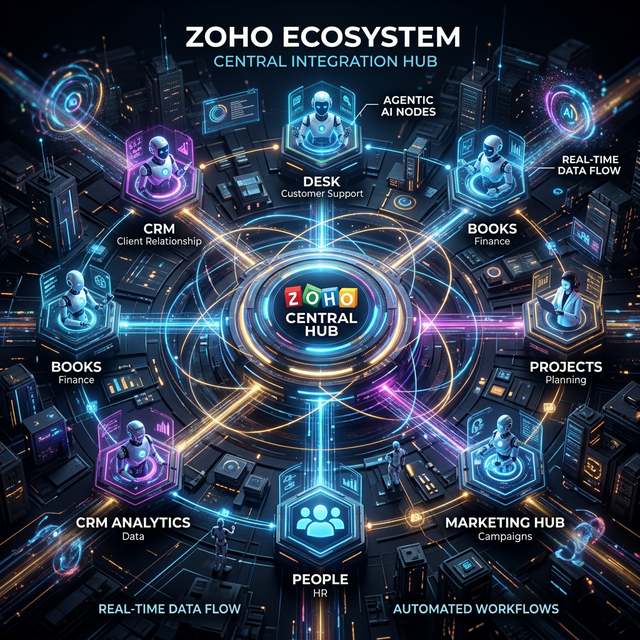
FI Digital specializes in elevating Zoho from a standard CRM into an AI-driven enterprise platform. By integrating Zoho CRM, Books, and People with advanced reasoning models like Claude and Gemini via n8n, we create autonomous workflows that handle qualification, VAT, and HR policy with 94% automation.
The market narrative is 'AI will replace Zoho.' We take the opposite view. Zoho is not a legacy CRM you're trying to escape. Zoho is an enterprise platform that will outlast this AI cycle, getting smarter with every addition. The question is not 'should we use Zoho?' but 'how do we architect Zoho for the AI era?' Zoho's strength is data clean, organized, multi entity, governance ready.
What Zoho lacks is agentic reasoning: the ability to understand business context, make judgment calls, and reason through complex scenarios. That's where Claude and Gemini come in. We bridge Zoho and modern AI through n8n orchestration, creating an 'AI elevated' Zoho platform. Your CRM doesn't just manage contacts it reasons about which contacts are most likely to close. Your finance system doesn't just record transactions it explains VAT treatment and flags anomalies. Your support system doesn't just log tickets it routes intelligently and suggests resolutions. We've deployed 80+ Zoho instances across APAC. Most started as 'just a CRM'; we've evolved them into integrated, AI ready enterprise platforms. The result: systems that scale, that stay compliant, that don't require constant customization, and that create competitive advantage.
How Does FI Digital's Zoho AI Architecture Differ from Standard CRM?
Most Zoho implementations are point and click configurations. We engineer Zoho implementations into scalable, intelligent enterprise platforms.
Advanced Data Models
We architect data structures specifically to support high-speed AI integration and reasoning loops.
n8n Orchestration
We embed complex business logic in n8n, not in restrictive Zoho DELUGE customization, for maximum flexibility.
Arabic Nuance
Native handling of Arabic dialects and UAE business etiquette in all AI agent interactions.
Engineered for Scale
Your system handles 10x growth without re-architecting. We build platforms, not just configurations.
How Does the Zoho Reasoning Layer Work with Claude and Gemini?
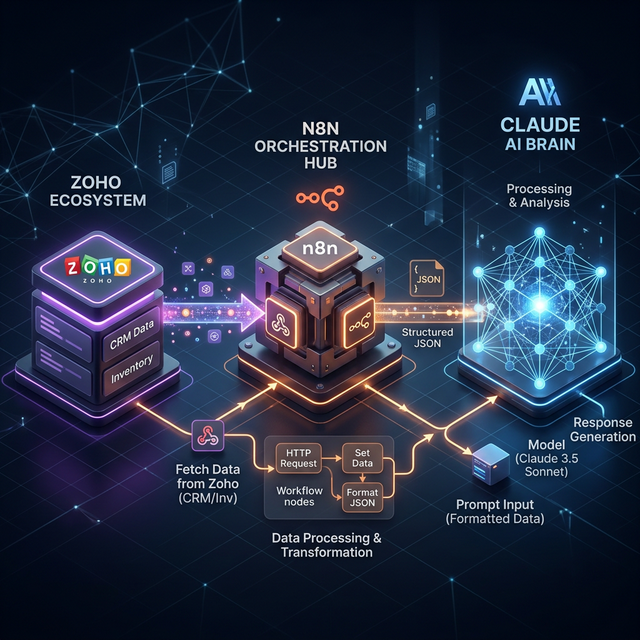
Here's how it works technically. When a sales opportunity comes in, n8n detects it (via Zoho webhook). n8n passes to Claude: opportunity data (company size, budget, product interest, past interaction history), company context (industry, region, company size range), and product data (pricing, competitive positioning). Claude reasons: based on this company and this opportunity, what's the likelihood of close? What's the concern? What should we do next? Claude proposes next step (schedule call, send white paper, escalate to VP). The response goes back to n8n, which updates Zoho (activity created, next step logged, likelihood updated). Across 100 opportunities/day, Claude is applying consistent, reasoned logic. No two opportunities are handled differently because a human was tired or distracted. The same applies to finance: when an expense is submitted, Claude understands policy, applies it, and either approves or flags. And HR: when a leave request comes in, Claude understands headcount impact, project deadlines, and policy, and routes accordingly. This is reasoning at scale.
Webhook Detection: n8n captures events from Zoho CRM/Books/Desk instantly.
AI Reasoning: Claude/Gemini processes data against company policies and product positioning.
Automated Response: n8n updates Zoho, creates activities, and logs reasoned next steps.
Which Zoho Modules Can Be Enhanced with Agentic AI?
Zoho is modular: CRM for sales, Books for finance, Desk for support, People for HR, Creator for custom apps, Analytics for reporting, Flow for automation. Most implementations use 2-3 modules. We architect using the full stack, with AI at each layer.
Zoho CRM + Sales Agent
Sales is about lead volume, qualification, and conversion. AI agent handles qualification (WhatsApp, web form, email inquiries all flow through agent). Zoho CRM is the system of record. Agent creates/updates leads, routes to right rep based on specialization and capacity. Rep focuses on selling (calling qualified leads, not qualifying).

Zoho Books + Finance Agent
Finance is about accuracy, compliance, cycle-time. AI agent handles AP/AR, bank rec, VAT, budget monitoring. Zoho Books is the system of record. Agent processes 94% of transactions. Humans focus on exceptions and strategy.
Zoho Desk + Support Agent
Support is about response speed and satisfaction. AI agent handles tier-1 (FAQ questions, order status, common issues). Zoho Desk routes to right agent. For complex issues, human takes over with full context.
Zoho People + HR Agent
HR is about policy compliance and employee experience. AI agent handles leave requests (applying policy, checking headcount, routing to manager), onboarding (creating tasks, sending documents, explaining processes), offboarding (ensuring nothing is missed). Zoho People is the system of record.

Zoho Creator + Custom Apps
Creator is the low-code platform within Zoho. You can build custom apps (inventory management, project management, etc.). AI integration means: custom app can have agentic behavior (inventory monitoring agent alerts when stock is low, procurement agent auto-creates POs, etc.). Most Creator implementations are configuration. We architect them with AI-readiness from the start.

Zoho Analytics + Insight Agents
Analytics is about reporting and insight. AI agents can generate insights automatically (anomaly detection: sales are 20% down this month, which customers are at risk, what changed?). Insight agents don't just report data; they analyze and recommend. Instead of a report saying 'Q2 revenue was AED 8.5M,' an agent says 'Q2 revenue was AED 8.5M, driven by a 23% increase in real estate (AED 3.2M) and a 12% decrease in hospitality (AED 1.1M due to Ramadan). The top-performing office was Dubai (42% of total) and bottom performer was India (15% of target). Recommend: increase India headcount and review hospitality pitch.
How Does Zoho Flow Work with AI-Driven Orchestration?
Flow is Zoho's native automation (like Zapier, but inside Zoho). Flow lets you build workflows: if X happening, do Y. AI enhances this: instead of if-then-else, you have intelligent conditionals (if opportunity is high-value and customer is enterprise, route to VP; if opportunity is mid-market and sales rep has capacity, route to rep). Most Flow implementations are simple. We architect complex, conditional workflows with AI decision-making.

What is the Technical Architecture of an AI-Powered Zoho Platform?
This is different from a typical 'Zoho + Zapier' architecture, which is just moving data around. This architecture adds intelligence through a multi-layered reasoning framework.

Zoho
Data, processes, approvals, and native integrations.

n8n
Receiving webhooks, routing to LLMs, and updating Zoho.


Claude / Gemini
Understanding context and making judgment calls.

LangChain
Retrieving relevant customer and product history.

Vector DB
Company FAQs, price lists, and policy documents.
"Vector DB (e.g., Pinecone, Weaviate) acts as the deep knowledge store (company FAQs, product info, pricing, policies) accessible to agents. This setup transforms Zoho from a record repository into a reasoning engine."
How is Zoho Configured for UAE Regulatory Compliance?
We don't just translate labels. We deeply configure Zoho for the UAE's unique regulatory and business environment from Day 1.
VAT Ready
Configured for UAE FTA rules and quarterly return preparation.
Labor Law
Salary and end-of-service calculations built for UAE law.
Data Sovereignty
Hosted in Zoho's UAE data centers for total compliance.
Arabic-First UX
Bilingual field labels and RTL support for native staff.
What are the Most Common Reasons Zoho Implementations Fail in the UAE?
Avoid the pitfalls of over-customization and chaotic governance. Our approach builds a platform, not just a system.
Reason 1: Over-Customization
Most teams see Zoho as 'like Salesforce, but cheaper,' and they customize it like Salesforce. They add 60+ custom fields, 40+ custom workflows, 20+ custom modules. This creates technical debt: every Zoho update requires testing your customizations; every team member needs to understand custom logic; maintenance becomes expensive. We architect for 80/20: 80% of your process should work with Zoho's standard tools. Only 20% should require customization. Customization should be in n8n (clean, testable, separate from Zoho), not in Zoho (hard to test, hard to maintain).
Reason 2: No Governance
Most teams let anyone change Zoho configuration. Sales adds a field, finance tweaks an automation, support changes a workflow. Within 6 months, the system is chaotic (conflicting automations, inconsistent field usage, broken integrations). We establish governance: only approved people can modify configuration, changes are documented, testing is required before production, audit trail of all changes. This sounds bureaucratic, but it prevents costly mistakes.
Reason 3: English-Only
Most Zoho partners are Western (US, EU, Australia). They configure in English, assuming users will speak English or will deal with English UX. In UAE, this is wrong. Your Arabic-speaking staff struggles with English CRM, make data entry errors, resist adoption. We configure bilingual from day 1.
Reason 4: No AI-Ready Thinking
Most implementations are manual-process-focused. 'How do we do this in Zoho?' instead of 'How do we architect this for intelligence?' A sales process might be: sales rep enters lead, follows up manually, closes deal. With AI-ready thinking: sales agent qualifies lead and routes to right rep based on specialization; rep focuses on closing. The second approach is more efficient and more scalable. We think about data architecture and AI readiness before building anything.
What is the Step-by-Step Implementation Methodology for Zoho AI?
A structured approach from discovery to steady-state operations.
Phase 1: Discover
Interview team, observe actual processes, identify pain points, assess data quality, evaluate current system (if migrating), baseline metrics.
Phase 2: Design
Architecture data model, design processes, spec integrations, design AI agent behavior, plan migration, design training plan.
Phase 3: Build
Set up infrastructure, configure Zoho, build n8n workflows, train agents, migrate data, run UAT, train team.
Phase 4: Deploy
Go live, monitor closely, optimize, transition to steady-state operations.
How Can I Optimize Zoho Licensing Costs for My Enterprise?
Zoho pricing is per-module, per-user, per-month. CRM: AED 60-200 per user per month. Books: flat rate AED 500-1,500 per month. Desk: AED 50-150 per user per month. The cost scales with users. A 50-person sales team on Zoho CRM can cost AED 150K+ per month.
We optimize: licensing by role (SDRs don't need full CRM, they need lite access), by module (do you need full Desk or just email integration?), and by substitution (can you use Desk for customer support instead of a separate platform?).
How Do I Migrate from Salesforce or HubSpot to an AI-Ready Zoho?
If you're coming from Salesforce, HubSpot, Dynamics, or another CRM, we handle migration: data extraction, cleansing (fixing bad data before it enters Zoho), mapping (old fields to new fields), validation (confirming migration accuracy), and go-live.
Salesforce Migration
Highly customized source. 8-12 weeks planning.
HubSpot Migration
Less customizable source. 6-8 weeks planning.
Common Questions About Zoho AI Integration for Dubai Enterprises
Is Zoho enterprise-ready?
What if we outgrow Zoho?
How do we move from one Zoho instance to another (e.g., US to UAE)?
Can Zoho handle our complex approval workflows?
What about integrations with other systems?
How much customization do we need?
What's the support model?
How Do I Get Started with an AI-Elevated Zoho Platform?
If you're considering Zoho for the first time, if you're struggling with your current Zoho implementation, or if you want to elevate your Zoho with AI, let's talk. We offer a Zoho Readiness Audit (AED 18K, 20-page report) that evaluates your current system, your architecture, your AI-readiness, and your optimization opportunities. No sales pitch. Just honest assessment.